


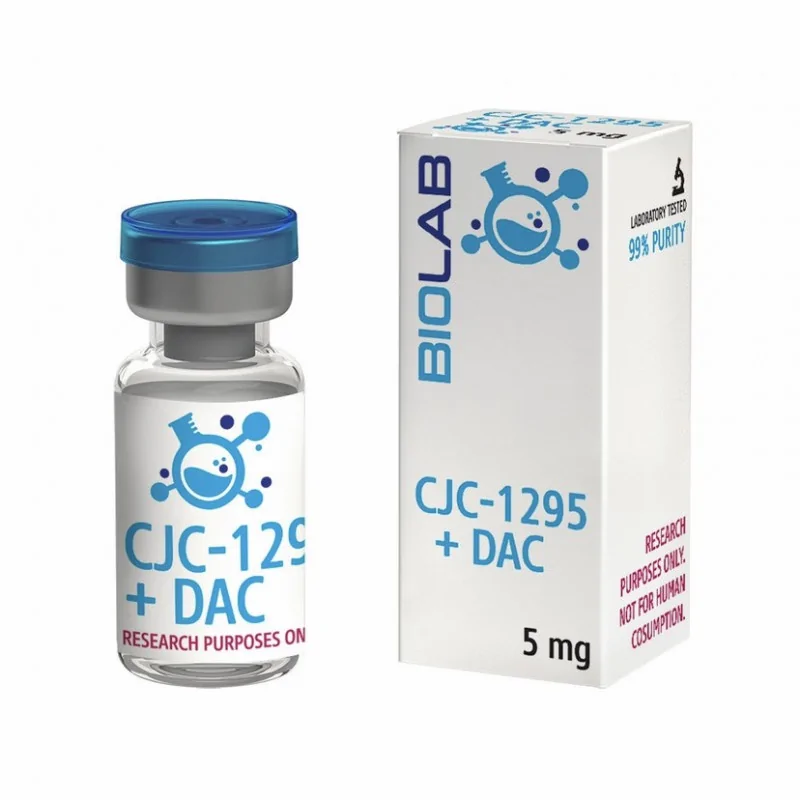

CJC-1295
Price range: £30.00 through £525.00
CJC 1295 Ipamorelin
CJC-1295 (with DAC) is a truncated peptide analogue of growth hormone releasing hormone (GHRH). First developed in the 1980s, research studies with modGRF have shown it to improve muscle repair and growth, accelerate wound healing, strengthen bones, increase fat burning, and improve metabolism. It may also have beneficial effects on blood sugar regulation and the immune system.

Where To Buy CJC-1295 Peptide – Long-Acting GHRH Analogue for Extended Growth Hormone Release
CJC-1295 (With DAC) is a long-acting Growth Hormone Releasing Hormone (GHRH) analogue designed to increase growth hormone (GH) production in a sustained manner. The DAC (Drug Affinity Complex) modification extends its half-life, allowing for stable GH release over several days with fewer injections compared to the No DAC version.
This makes CJC-1295 (with DAC) particularly effective for long-term research into fat metabolism, muscle growth, recovery, and anti-ageing, providing convenience and efficiency in extended peptide protocols.
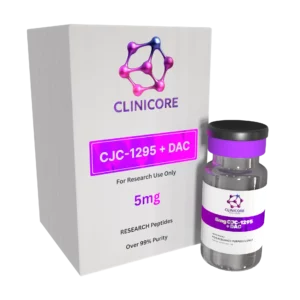
It is a peptide that researchers posit may function similarly to growth hormone-releasing hormone (GHRH), potentially increasing the endogenous production of growth hormone (GH) within the organism. The peptide is a synthetic 29 amino acid analog of GHRH.
It is the shortest functional analog of GHRH that still has the potential capacity to trigger GH release from the somatotroph cells in the pituitary gland. Moreover, 4 of the original 29 amino acids in this fragment are substituted in it, to possibly improve the pharmacokinetics of the peptide and prolong its half-life.
Overview
CJC-1295 DAC is recognized by many names: CJC-1295, CJC-1295 with DAC, DAC:GRF, long-acting GHRH analog, and synthetic GHRH analog. Theoretically, as the peptide is considered a releasing factor for growth hormone, it has been studied for its potential role in:
- The reduction of fat mass by using fat cells as an energy source. It may lead to increased muscle mass via the promotion of protein synthesis.
- Since growth hormone is considered to promote bone growth and improved joint and connective tissue, CJC peptide may potentially improve bone mass and thereby reduce the risk of damage.
- Studies have suggested that GHRH may support the centers in the nervous system for sleep, and potentially this action may be mirrored by analogs
The DAC component is a biochemical complex that may further increase the half-life of the peptide. This phenomenon might be ascribed to the alleged capability of the DAC to bind to proteins present in plasma. More precisely, the DAC component appears to entail the attachment of a lysine derivative, identified as N-epsilon-3-maleimidopropionamide, to the C terminus of CJC DAC. Integrating this modified amino acid sequence with the DAC component might conceivably enhance the pharmacokinetics of CJC-1295 DAC, extending its half-life to approximately 8 days. Simultaneously, it appears to maintain a significant affinity for GHRH receptors, similar to the affinity exhibited by CJC-1295 without DAC.(2)
This does not imply that CJC without DAC has no relevance or use in present day research. For example, CJC without DAC & Ipamorelin blend has been studied for its suggested synergistic potential, as combining GHRH analogs with peptides that appear to activate the ghrelin receptors in the pituitary gland. It is also posited to result in greater GH-synthesis response from the somatotroph cells.(3)

Chemical Makeup
Molecular Formula: C152H252N44O42
Molecular Weight: 3367.95 g/mol
Other Known Titles: Tetrasubsituted GRF 1-29 with DAC
DAC vs No-DAC
DAC (Drug Affinity Complex)
When a peptide is labeled as having DAC, it means that it includes a biochemical modification that extends its half-life and duration of action in the body. For CJC-1295 with DAC, this modification allows the peptide to bind more effectively with blood proteins, particularly albumin. This binding prolongs the peptide’s presence in the bloodstream, resulting in a longer period of action. The extended half-life means that CJC-1295 with DAC does not have to be administered as frequently as its No-DAC counterpart.
No-DAC – Mod GRF (1-29)
On the other hand, CJC-1295 without DAC, often referred to as Mod GRF (1-29), does not include this modification. As a result, it has a much shorter half-life in the body. The absence of DAC means this peptide more closely mimics the body’s natural GH release patterns, leading to a more rapid onset and shorter duration of action. This characteristic requires more frequent dosing to maintain its efficacy.
| Types | With DAC, No DAC |
|---|---|
| Dosage | 2MG, 5MG, 10MG |
| Quantity | 1, 5, 10 |
Be the first to review “CJC-1295”
Related products

Peptides


Peptides


Peptides


Peptides


Peptides

Peptides

Peptides
Reviews
There are no reviews yet.