
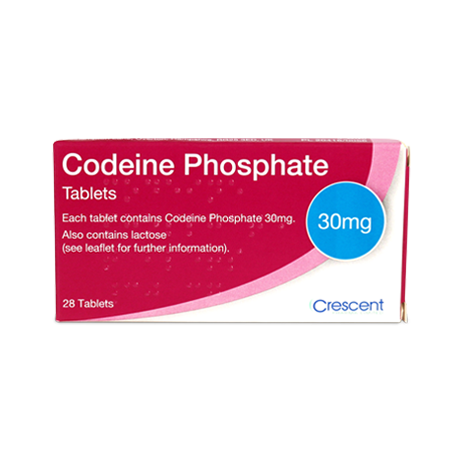


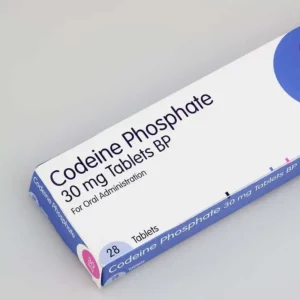
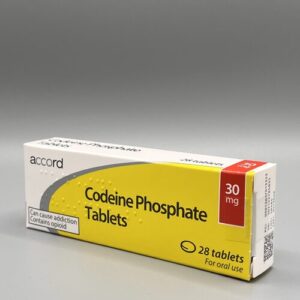

What Is Codeine Phosphate Tablets
Codeine Phosphate 30mg is a prescription medication widely used to manage moderate pain, suppress persistent coughs, and treat diarrhea. At Health First Meds, we provide top-quality Codeine Phosphate for those seeking reliable pain relief with convenient online

Codeine Phosphate 30mg is an established, familiar and widely used analgesic. It is considered a weak opioid, with a potency around one tenth that of morphine (i.e. 60mg of codeine is equivalent to around 6mg of morphine). Codeine is administered in doses of 15–60mg up to four times per day (maximum of 240mg in 24 hours) and confers beneficial analgesic, antitussive and antidiarrhoeal effects
Despite its utility and ubiquity, codeine actually has little or no analgesic activity until it is metabolised into morphine. Consequently, codeine can be regarded as a prodrug (a compound that is pharmacologically inactive until it is metabolised into an active form by the human body)
The extent of this metabolism varies however: individuals with differing CYP2D6 enzyme activity may derive differing effects (and associated adverse effects) from the same dose of codeine. Additional limitations include the potential for drug–drug interactions, and a so-called ‘ceiling effect’ that adversely tips the risk–benefit scale at supratherapeutic doses. To appreciate the wide-ranging clinical significance of these factors fully, the metabolism of codeine must first be understood.
The ‘ceiling’ effect
When used for the management of pain, codeine is generally considered to have a ‘ceiling’ effect. Although this is not an absolute ceiling, this term describes a point where the analgesic benefit of further dose escalation is often outweighed by the increasing burden of adverse effects, thus limiting dose escalation beyond a certain point. Doses of codeine should not exceed the licensed maximum of 240mg in 24 hours (in divided doses).
This maximum has been derived in part from studies indicating that dose escalations beyond this point cause an increase in adverse effects —including sedation, dizziness, nausea and vomiting — with limited additional analgesic efficacy. In practice, the ceiling effect is circumvented by prescribing within the licensed therapeutic window.
Metabolism
Codeine Phosphate 30mg is primarily metabolised by two different pathways. In most people, around 80% of codeine is conjugated to form codeine-6-glucuronide, which may have weak analgesic activity. However, typically less than 10% of codeine undergoes CYP2D6-mediated O-demethylation to the potent analgesic, morphine.

The CYP2D6 enzyme belongs to the CYP450 super-family of enzymes, which are responsible for the metabolism of many drugs and endogenous compounds.
These enzymes exist throughout the body, but are most prevalent in the liver. The expression and function of these enzymes can be altered by genetic variation, with large inter-ethnic differences being observed. For example, clinically significant alterations in CYP2D6 functionality are known to affect Caucasians (5–10%) and Africans (0–34%) more than Asians (≤1%).
Such variations can significantly affect how an individual responds to a drug. This can be said to be true of codeine. The extent of that conversion can vary from none to potentially too much, meaning that, for some people, codeine may not be the right choice of analgesic.
In practice, the CYP2D6 metabolism status of patients can be determined through clinical observation. Poor metabolisers may experience limited to no therapeutic response to Codeine Phosphate 30mg(also see drug–drug interactions below), while those displaying signs of opioid toxicity — such as respiratory depression, myoclonic twitches, confusion and hallucinations — may be ultra-rapid metabolisers.
In both cases, the most appropriate course of action may be to discontinue codeine and decide, along with the patient and prescriber, on an alternative analgesic. For example, pharmacists can liaise with prescribers and suggest starting low-dose morphine (10mg modified-release morphine sulphate twice daily) in place of codeine, if appropriate.
If the patient is thought to be a poor metaboliser, a ‘wash out’ period does not need to be observed, but if toxicity to codeine is suspected, prescribers should wait for signs of toxicity to abate as the drug washes out before prescribing an alternative. In the latter scenario, specialist input is advised.
| Dosage | 15mg, 30mg |
|---|---|
| Quantity | 28 Tablets, 60 Tablets, 100 Tablets |
Be the first to review “Codeine Phosphate 30mg”
Related products


Pain Relievers
Pain Relievers

Pain Relievers

Pain Relievers
Pain Relievers
Pain Relievers
Pain Relievers
Reviews
There are no reviews yet.